Many people are still not fully aware of the names of all the Indian States and their Capitals. To enhance the general knowledge of every citizen, it is important to know these facts. As of 2025, India has 28 States and 8 Union Territories.
Each state has its own administrative, legislative, and judicial capital, while the Chief Minister serves as the head of the state government. Similarly, the Union Territories are administered directly by the Central Government, with some having their own legislatures.
In this article, we present a comprehensive list of States, Union Territories, and their Capitals, to provide readers with a clear overview of India’s political geography. Understanding this not only builds awareness but also highlights the importance and contribution of every region to the unity and diversity of the nation.
States and Capitals of India
India is the seventh-largest country in the world by land area and the second-most populous nation, after China. It is known for its diverse culture, heritage, and traditions, which are reflected across its 28 states and 8 Union Territories, each having its own distinct identity, language, and history.
Located in South Asia, India is governed under a parliamentary system of democracy as outlined in the Constitution of India. Due to its vast size and diversity, the Constitution empowers the central government to form states and union territories for better administration and governance.
For every Indian citizen, having knowledge about the states and their capitals is important, not only as part of general awareness but also because such questions are frequently asked in competitive exams and interviews conducted across the country.
| List of Indian States, Capitals and Formation Date | |||
|---|---|---|---|
| S.No. | State/UT | Capital | Formation Date |
| 1 | Andhra Pradesh | Amaravati | 1 November 1956 |
| 2 | Arunachal Pradesh | Itanagar | 20 February 1987 |
| 3 | Assam | Dispur | 15 August 1947 |
| 4 | Bihar | Patna | 22 March 1912 |
| 5 | Chhattisgarh | Naya Raipur (Atal Nagar) | 1 November 2000 |
| 6 | Goa | Panaji | 30 May 1987 |
| 7 | Gujarat | Gandhinagar | 1 May 1960 |
| 8 | Haryana | Chandigarh | 1 November 1966 |
| 9 | Himachal Pradesh | Shimla | 25 January 1971 |
| 10 | Jharkhand | Ranchi | 15 November 2000 |
| 11 | Karnataka | Bengaluru | 1 November 1956 |
| 12 | Kerala | Thiruvananthapuram | 1 November 1956 |
| 13 | Madhya Pradesh | Bhopal | 1 November 1956 |
| 14 | Maharashtra | Mumbai | 1 May 1960 |
| 15 | Manipur | Imphal | 21 January 1972 |
| 16 | Meghalaya | Shillong | 21 January 1972 |
| 17 | Mizoram | Aizawl | 20 February 1987 |
| 18 | Nagaland | Kohima | 1 December 1963 |
| 19 | Odisha | Bhubaneswar | 1 April 1936 |
| 20 | Punjab | Chandigarh | 1 November 1966 |
| 21 | Rajasthan | Jaipur | 30 March 1949 |
| 22 | Sikkim | Gangtok | 16 May 1975 |
| 23 | Tamil Nadu | Chennai | 26 January 1950 (renamed from Madras State in 1969) |
| 24 | Telangana | Hyderabad | 2 June 2014 |
| 25 | Tripura | Agartala | 21 January 1972 |
| 26 | Uttar Pradesh | Lucknow | 24 January 1950 (renamed from United Provinces) |
| 27 | Uttarakhand | Dehradun (Winter), Gairsain (Summer) | 9 November 2000 |
| 28 | West Bengal | Kolkata | 15 August 1947 |
Indian Union Territories and Capitals
At present, India has 8 Union Territories. One of the most significant changes in recent years was the reorganization of the erstwhile state of Jammu and Kashmir. On 5–6 August 2019, the Indian Parliament passed the Jammu and Kashmir Reorganisation Act, under which Article 370 and Article 35A were abrogated. This historic step removed the special status of Jammu and Kashmir.
Following this, the state was bifurcated into two Union Territories — Jammu & Kashmir and Ladakh — with effect from 31 October 2019. This was the first instance of a state being reorganized and downgraded into Union Territories.
With this change, India officially comprises 28 States and 8 Union Territories today. Each Union Territory is administered differently, with some having their own legislatures and others being directly governed by the Central Government through an appointed Lieutenant Governor or Administrator.
| List of Indian Union Territories, Capitals and Formation Date | |||
|---|---|---|---|
| S.No. | Union Territory | Capital | Formation Date |
| 1 | Andaman and Nicobar Islands | Port Blair | 1 November 1956 |
| 2 | Chandigarh | Chandigarh | 1 November 1966 |
| 3 | Dadra and Nagar Haveli and Daman and Diu | Daman | 26 January 2020 (merger) |
| 4 | Lakshadweep | Kavaratti | 1 November 1956 |
| 5 | Delhi (NCT) | New Delhi | 1 November 1956 (NCT status 1991) |
| 6 | Puducherry | Puducherry | 1 November 1954 (UT status 1963) |
| 7 | Ladakh | Leh | 31 October 2019 |
| 8 | Jammu and Kashmir | Srinagar (Summer), Jammu (Winter) | 31 October 2019 |
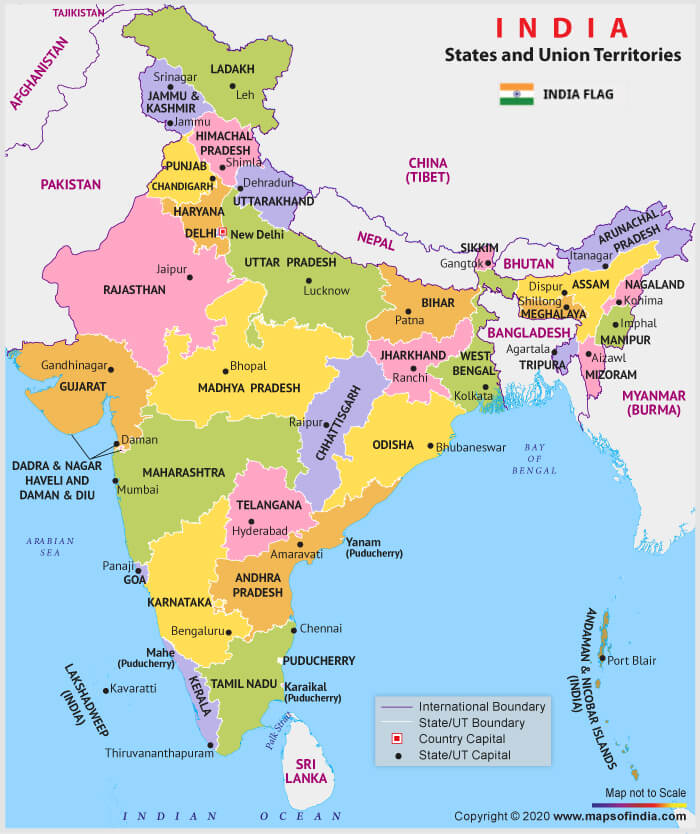
States and Capitals of India Map
You can check the latest political map of India which provides the total number of states and union territories in India and their capitals at present.
Latest Updates
- Since 26th January 2020, India had 8 union territories. The U.T Daman and Diu, Dadra and Nagar Haveli have merged into a single union territory. With this merger, the number of UTs has come down to eight.
- On August 5, 2019, the central government also announced the abrogation of the special status given to Jammu and Kashmir under Article 370 and its division into two Union Territories i.e. UTs of Jammu and Kashmir, and Ladakh. Ladakh got a Union Territory status officially on October 31, 2019.